A commit can tell you that a team replaced a queue, changed a database, or moved work out of a request. It rarely tells you why the original design stopped fitting, which alternatives were rejected, or what constraint mattered most at the time.
That missing reasoning is the difference between a code history and an engineering history.
Commits answer a different question
Version control is an extraordinary record of state. A diff shows the exact lines that changed, and a disciplined commit message can add intent. But a commit is optimized around a unit of code change, not around a unit of reasoning.
One engineering decision can span several commits. One commit can also include routine refactoring, generated output, and a meaningful architectural choice. Forcing both into the same shape makes the decision hard to recover later.
Consider a service that starts with an in-memory rate limiter. The code records the implementation. The durable context is richer:
- the application currently runs as a single instance;
- Redis would add deployment and operational work;
- a narrow interface preserves a migration path;
- the team will revisit the choice when horizontal scaling becomes real.
Without those constraints, a future reader can mistake a deliberate trade-off for an oversight.
A useful trail stays sparse
The answer is not to save every message, command, or thought. High-volume logs transfer the burden from writing context to searching for it.
A practical engineering decision trail should record only three kinds of meaningful event:
- Decisions — choices between credible alternatives.
- Problems — failures or blockers that change the path.
- Resolutions — solutions linked back to the problem they address.
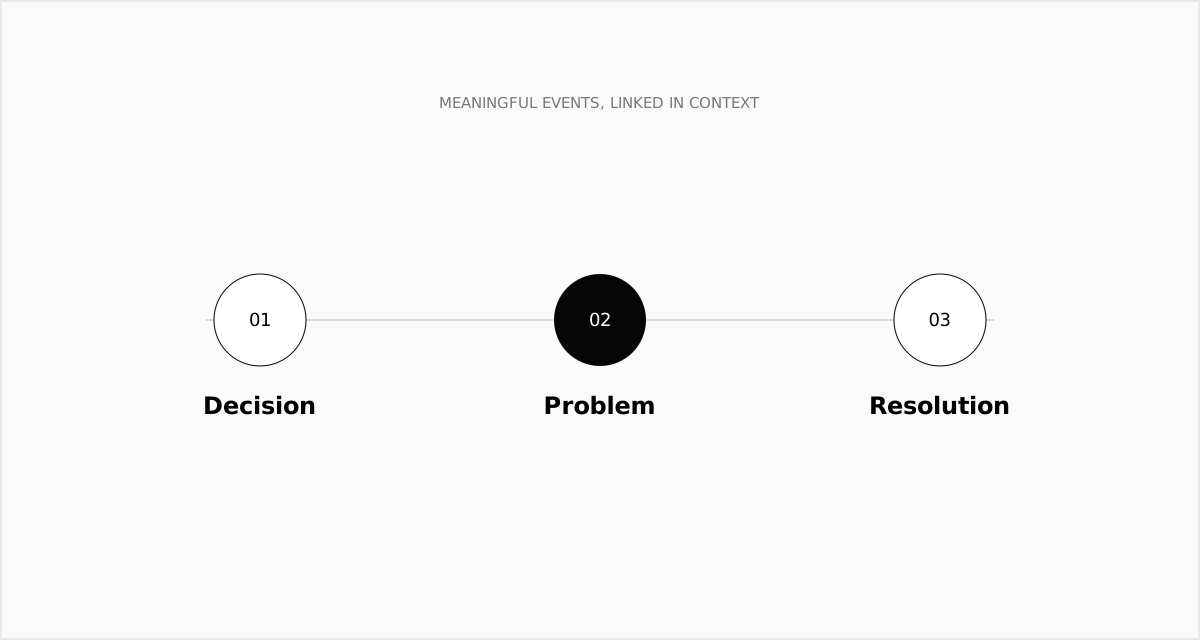
This structure creates a readable causal chain. A reviewer can see what the team believed, what reality challenged, and how the implementation adapted.
Capture context while it is still available
Retrospective documentation is difficult because context decays quickly. Once the build works, discarded alternatives feel less plausible than they did during the decision. Constraints are forgotten. Reasoning gets rewritten around the successful outcome.
Coding agents have a useful position in this workflow: they are present while alternatives are considered and problems are diagnosed. With a small set of structured tools, an agent can preserve a meaningful event at the moment it becomes clear.
The event should remain explicit and attributable:
decision: Keep SQLite for the local MVP
context: The service runs as one process on one host
alternatives: PostgreSQL
reasoning: Avoid deployment overhead while preserving a repository boundary
decision_maker: developer
initiator: agent
The provenance fields matter. If an agent suggested the approach and a developer approved it, the record should not pretend the developer originated the reasoning.
Context improves future changes
A decision trail is useful at several moments:
- Code review: reviewers understand the trade-off before debating the implementation.
- Onboarding: new teammates learn the boundaries the current architecture was designed around.
- Incidents: responders can connect a failing assumption to the choice it informed.
- Migration: teams know which threshold was expected to trigger a more complex system.
- Portfolio review: builders can explain how they handled uncertainty, not only show the finished interface.
The goal is not to make every decision permanent. It is to make decisions legible enough to revisit.
Start with one repository
Choose a project where architectural choices are still active. Connect the tool, then record only moments that would be expensive to reconstruct next month.
Journey’s setup guide explains how to connect Codex or Claude Code. You can also inspect the Try Oz example journey to see how sparse events become a readable build narrative.
The code will continue to show what you built. A small, well-structured trail can preserve how you got there.